
Arban Trumpet Method in PDF + Interactive Sheet Music
The “trumpeter’s Bible”: Jean-Baptiste Arban’s technical exercises, arranged by type and difficulty, to take you from elementary level all the way to advanced.

Listen before you play
A scale exercise from the Arban (p. 59, ex. 1) in MIDI & MusicXML Player, with note names and valve fingerings. Hit play and listen.
Content of the Arban’s method
Organization of exercises by difficulty
The Arban is arranged by type of exercise and, within each type, by difficulty, so it is not studied from cover to cover. As a rough guide, this is how the 581 exercises of its technical part are organized by difficulty, with their page in the book:
Jean-Baptiste Arban and his method
Probably the Arban’s method (link to Amazon) for trumpet (also valid for cornet and other brass instruments) is, as is commonly said, the trumpeter’s Bible. Why? Simply because it is almost certainly the most voluminous and complete trumpet method ever written for this instrument.
This method has exercises for almost every technical aspect that a trumpet student needs to know, and although the types of exercises are detailed below, it covers a wide variety of them (flexibility, technique, scales, studies, etc.).
Although the Arban method starts with simple exercises, it cannot be considered the best method to get started in the world of the trumpet, since it does not contain a large selection of beginner exercises and, in addition, it quickly increases in difficulty, so it can be somewhat demanding. However, as soon as you have a basic level and register (at least up to a G above the staff) you can start studying it without any problem.
Read more
On the other hand, it is a method organized by type of exercises, so it should not be studied in order from start to finish. Within each type of exercise, they are ordered by difficulty, but it is possible that page 100 has simpler exercises than page 50. Therefore, it is necessary to be clear about what you want to study at each moment and in this way, look for the most suitable exercise.
Going into detail, it can be said that the Arban method is made up of two parts:
- A more technical first part, made up of individual exercises where one or another technical facet of the instrument is practiced. In it you can find exercises of the following types:
- First studies: this is the simplest part of the method, where you start with long note exercises and get more complicated until you reach eighth notes and sixteenth notes. In addition, syncopation and 6×8 exercises are included.
- The second part focuses on slurred notes, where the note is changed with the valves or through lip flexibility.
- The entire third part focuses on major, minor, and chromatic scales in all keys.
- In the fourth part you will be able to rehearse everything related to ornaments (turns, appoggiaturas, mordents, etc.)
- The fifth part, called advanced studies, covers different topics: such as intervals, triplets, thirty-second notes or cadenzas.
- Finally, a part is included to practise double and triple tonguing.
- A second, more musical part, made up of different songs, duets, works and characteristic studies to put into practice everything learned in a more interpretive context. Basically 4 types of exercises are included here:
- The Art of Phrasing, containing 150 melodies.
- 68 duets for two trumpets.
- 14 characteristic studies, of a much higher complexity.
- 12 fantasies that includes the famous “Carnival of Venice”
The Arban method is so extensive that it has exercises from a basic level (although not for absolute beginners), up to exercises typical of virtuoso trumpeters. In other words, it is a method that will accompany you, practically, throughout your life as a trumpeter, and if you are able to finish it, it means that you will have become a great virtuoso of the instrument.
Organizing the more than 500 exercises of this method is extremely complex, so the table follows the syllabuses of several Spanish conservatories and groups each type of exercise in the year in which it is usually studied. If you think any of them should be at another level, send a message from the contact page and it will be corrected.
Shortcomings of the Arban’s method
Although the Arban method is, as already mentioned, very, very complete, it can also be said that there are certain aspects that it does not cover, for which it would be necessary to focus on other methods that go deeper. For example:
- It doesn’t make any special mention about the warm-up, so you have to resort, for example, to the Stamp method or similar.
- It is not a suitable method if you want to practise the high or very high register.
- Likewise, it is also not suitable for the study of pedal notes.
- Finally, bear in mind that it is a book that dates back to 1859, so no type of study of modern music, jazz or improvisation can be expected.
Arban’s method in PDF
You also have the option to download the Arban method in PDF.
On the internet you can find different versions (English, Spanish, with different publishers, versions, etc…). However, most of those versions contain only the first part (the technical part, not the musical part). Luckily, here you have all those “loose parts” gathered into a single Arban PDF that contains all the content explained above.
The Carnival of Venice for trumpet in PDF
One of the best known fantasies, especially due to the difficulty of its execution, is The Carnival of Venice.
For this reason, it has its own section here in case you simply want to download this wonderful work with piano accompaniment. If it is the first time that you face it, it is a good idea to practise it in MIDI & MusicXML Player, lowering the tempo a lot, since there are extremely fast variations in its execution.
Performance of the Arban’s method
Here are some examples of the performance of this method to give you an idea of how it sounds and how difficult it is.
First part (technical)
 Arban Trumpet Method video 1
 Arban Trumpet Method video 2
 Arban Trumpet Method video 3
 Arban Trumpet Method video 4
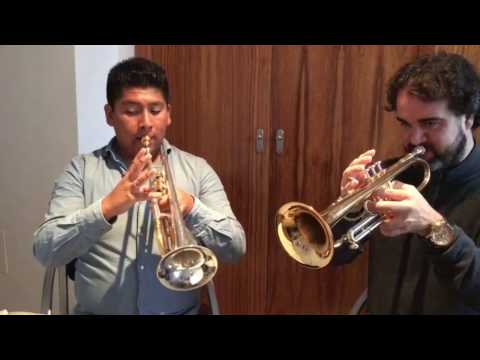 Arban Trumpet Method video 5
 Arban Trumpet Method video 6
Second part (songs, duets, fantasies and The Carnival of Venice)


Practice the Arban Method with Interactive Sheet Music
Buy Arban’s method
It is always highly recommended to have the methods and pieces in physical format (paper). In this way you will be able to create a great personal library, which will allow you one day to rediscover exercises that you had forgotten, lend your family and friends a book from your collection, or simply look at it and make you remember how hard (and at the same time exciting) was interpreting that work that you have overcome today.
That is why here is a selection of the most recommended, affordable and best-selling products, so that you can quickly get them from Amazon.
Affiliate link: as an Amazon Associate I earn from qualifying purchases.
 Solos from Spanish bandsTrumpet Soloist – International EditionA selection of the best band trumpet solos from Spain, in a book written in English. PDF with online audio.See the book
Related Methods
 Bai Lin – Lip Flexibilities – Online Audios
 Carmine Caruso – Musical Calisthenics for Brass – Online Audios
 H. L. Clarke – Technical Studies for the Cornet in PDF + Interactive Sheet MusicInteractive
 James Stamp – Warm-Ups and Studies – Online Audios
 Original Louis Maggio System For Brass – Online Audios
 Total Range – PDF + Online Audios